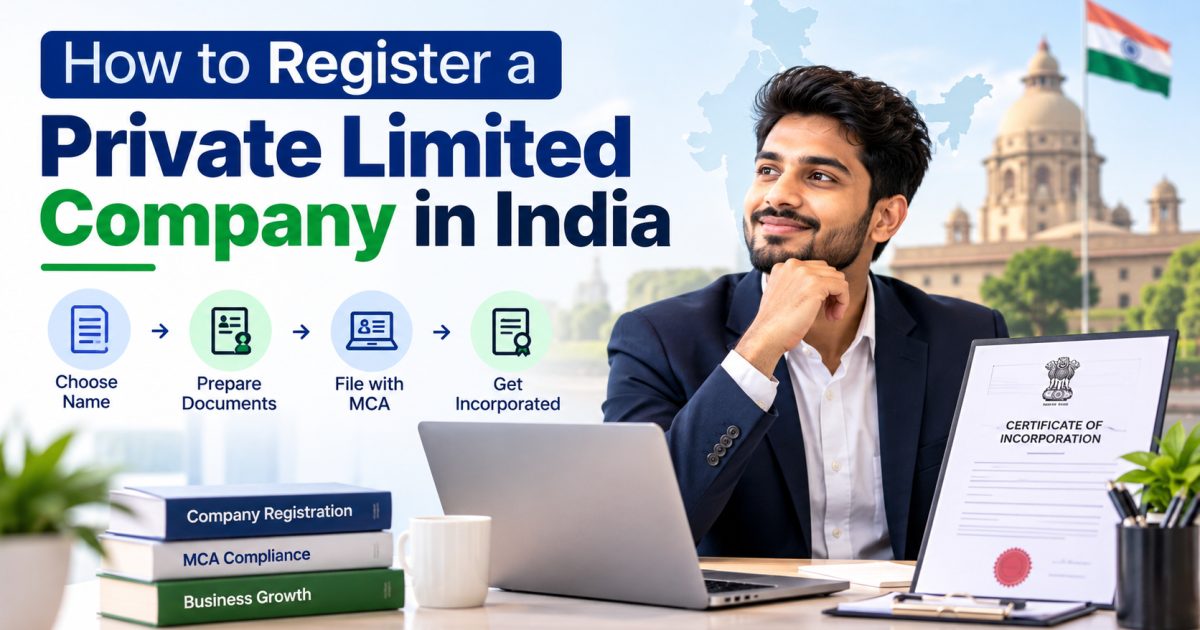
Why Choose a Private Limited Company
A private limited company (PLC) is the most popular business structure for startups and SMEs in India. It offers limited liability, a separate legal identity, and easier access to funding. If you plan to grow, protect personal assets, and attract investors, forming a PLC is usually the best option.
Key Requirements for Registration
Before you start the paperwork, make sure you meet the basic eligibility criteria set by the Ministry of Corporate Affairs (MCA):
- At least two shareholders (individuals or entities) and a maximum of 200.
- Minimum two directors, each must be at least 18 years old and have a DIN (Director Identification Number).
- A registered office address in India where official documents can be served.
- Paid‑up share capital of at least INR 1 lakh (no minimum for most sectors).
Step‑by‑Step Registration Process
The entire procedure can be completed online through the MCA portal (www.mca.gov.in). Follow these steps for a smooth registration:
1. Obtain Digital Signature Certificates (DSC)
All proposed directors need a Class III DSC to sign electronic documents. You can get a DSC from any certified agency; the process usually takes 1–2 days.
2. Apply for Director Identification Number (DIN)
File Form DIR‑3K on the MCA portal with the DSC. The MCA will issue a DIN within a few hours if the details are correct.
3. Choose and Reserve a Company Name
Use the RUN (Reserve Unique Name) service to check name availability. You can propose up to two names. Once approved, the name reservation is valid for 20 days.
4. Draft the Memorandum and Articles of Association (MOA & AOA)
The MOA defines the company's main business activities, while the AOA outlines internal rules. Templates are available on the MCA portal, but customizing them to suit your business is advisable.
5. File Incorporation Forms
Submit the following forms online:
- SPICe (Simplified Proforma for Incorporating Company) – combines multiple applications into one.
- SPICe + INC – for incorporating a PLC.
- e‑MGT (e‑Form for GST registration) – optional at this stage but recommended.
Attach the signed MOA, AOA, DIN, and DSC details. Pay the applicable fees (see next section).
6. Obtain Certificate of Incorporation
After MCA verification, you will receive the Certificate of Incorporation (COI) with a unique Corporate Identification Number (CIN). This is the legal proof that your company exists.
7. Apply for PAN and TAN
Use the COI to apply for a Permanent Account Number (PAN) and Tax Deduction and Collection Account Number (TAN) through NSDL or UTIITSL.
8. Open a Bank Account
With the COI, PAN, and AOA, you can open a current account in the company’s name. Deposit the paid‑up capital as per the AOA.
Documents Needed
Prepare the following documents before you start:
- Identity proof (Aadhaar, PAN) and address proof for each director.
- DSC for each director.
- DIN (if already obtained).
- Proof of registered office (electricity bill, rent agreement, NOC).
- MOA and AOA (signed in the presence of a notary).
- Letter of Authorization and Consent from directors.
Fees and Timeline
The cost varies with the authorized capital and the state, but typical fees are:
- DSC: INR 1,500 – 2,500 per director.
- DIN application: INR 500 per director.
- Name reservation (RUN): INR 1,000.
- SPICe filing fee: INR 2,000 – 5,000 (depends on capital).
- Stamp duty on MOA/AOA: INR 200 – 2,000.
- Professional fees (if you hire a chartered accountant or company secretary): INR 5,000 – 15,000.
When all documents are ready and fees are paid, the MCA typically processes the incorporation within 7‑10 working days. If there are no objections, you can receive the COI in as little as 3 days.
Common Mistakes to Avoid
Even small errors can delay registration. Keep an eye on these pitfalls:
- Incorrect DIN or DSC details: A typo will cause the form to be rejected.
- Mismatch between MOA activities and actual business: The MCA checks for alignment; any discrepancy leads to a notice.
- Improper registered office proof: Ensure the address proof is recent (not older than 2 months).
- Missing signatures on MOA/AOA: All directors must sign; otherwise, the filing is incomplete.
Consider using a professional service or a chartered accountant to double‑check the paperwork, especially for first‑time entrepreneurs.
What Happens After Incorporation?
Once your PLC is live, you must comply with post‑incorporation formalities:
- Hold the first board meeting within 30 days to appoint an auditor and adopt the statutory registers.
- File Form INC‑22 to confirm the registered office within 30 days.
- Maintain statutory books (shareholder register, board minutes, etc.) at the registered office.
- File annual returns and financial statements with the MCA each year.
Staying compliant protects your limited‑liability status and avoids penalties.
This article provides general information and is not legal advice.